Announcements Information

Fundamentals of Lens Moulds Information Title
An easy-to-understand explanation of the types and structures of lens molds, the required precision, and the key points that influence molding quality.
We introduce the technologies for stable mass production of high-quality optical lenses and the essential points to consider when making molds.
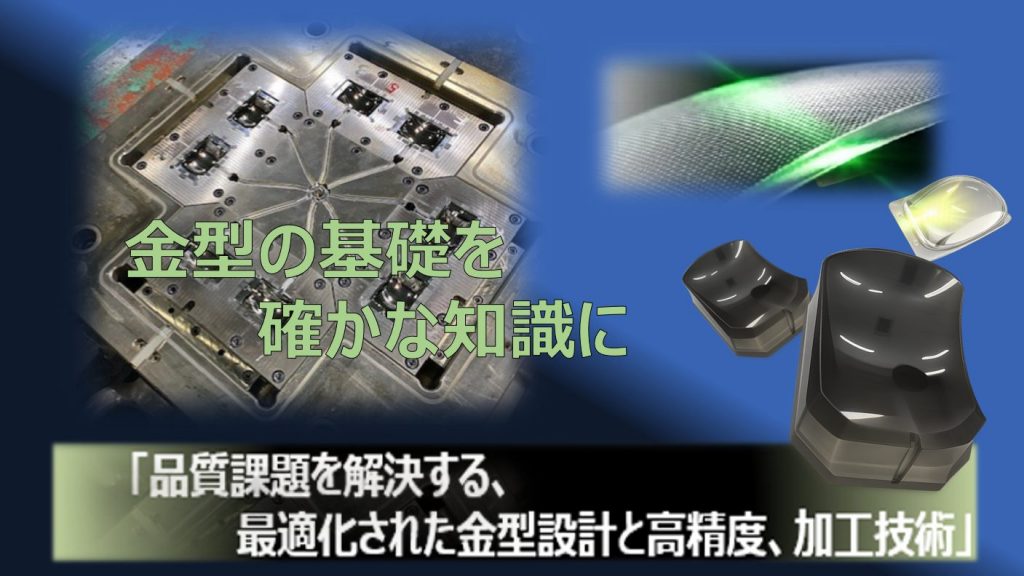
Mold Structure, Processing, and Management Technologies for High-Precision Lenses
Table of Contents
Lens Mold Fundamentals
What is a Lens Mold?
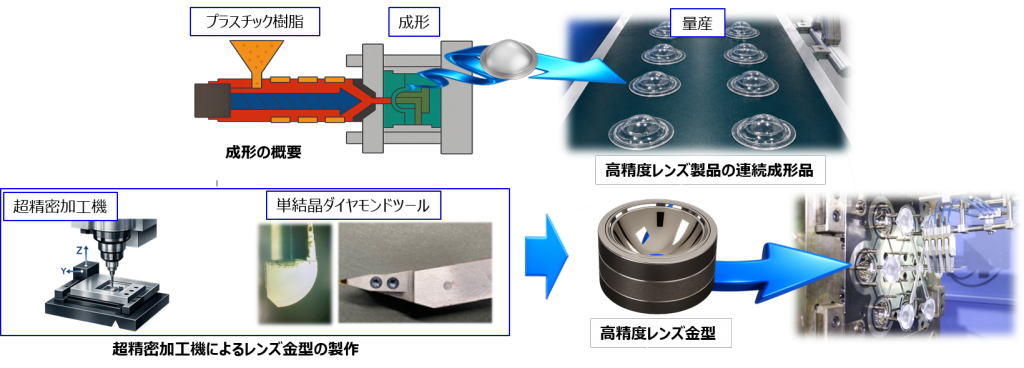
A lens mold is a mold used to mass-produce plastic lenses with high precision.
To meet optical performance requirements, it demands significantly higher precision compared to general molding dies.
The surface shape of the mold is reflected in the lens's curvature and optical characteristics.
By molding through methods such as flowing material into the mold or pressing, high-quality lenses with the same shape and performance are stably mass-produced.
Grinding and diamond cutting using ultra-precision machining equipment are employed.
It is characterised by an extremely smooth surface and very high shape accuracy.
Lens Types and Characteristics 1
1. Spherical Lens
- Shape Characteristics
Surface is a perfect sphere
Radius of curvature is constant - Optical Characteristics
Easy to design and analyse
Spherical aberration always occurs - Applications
Simple converging lenses / Low magnification lenses / Low-cost cameras / Lighting

2. Aspherical Lens
- Shape Characteristics
Rotationally symmetric
Curvature changes from the centre of the shape - Optical Characteristics
Significantly reduces spherical aberration and coma aberration - Applications
Camera lenses / Projector lenses / Smartphone lenses / Optical communication lenses / Automotive headlamp lenses
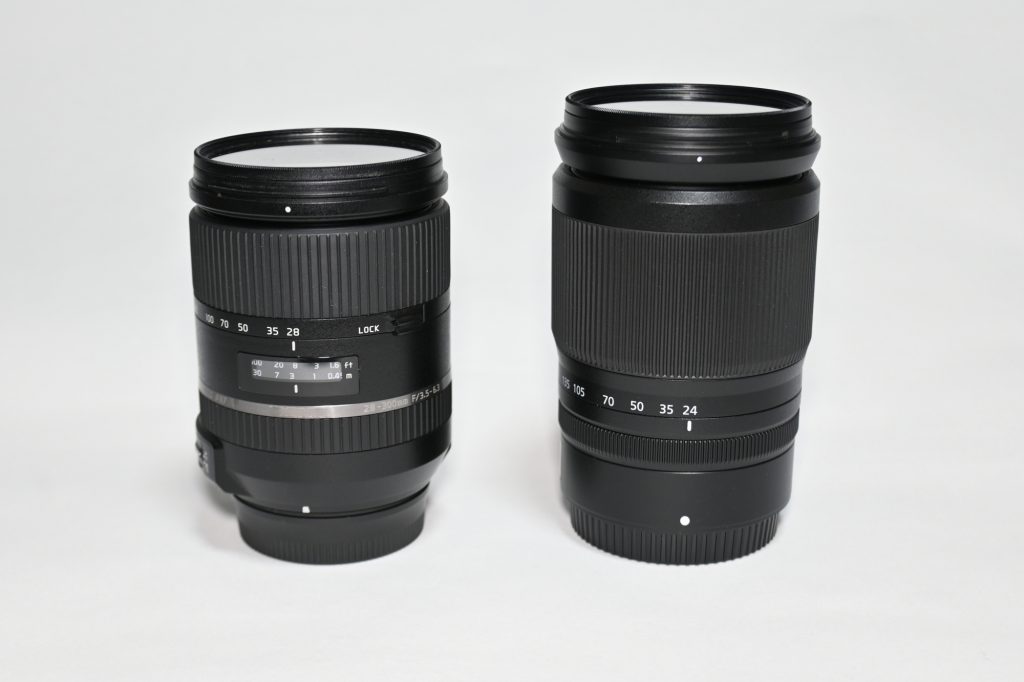
3. Freeform Lenses
- Shape Characteristics
Shape differs in the X and Y directions, which are not rotationally symmetric.
A three-dimensional curved surface that is difficult to express with mathematical formulas. - Optical Characteristics
High degree of design freedom.
Asymmetric aberration correction is possible.
Dramatic miniaturisation of optical systems. - Applications
AR/VR headsets / Automotive headlamps / HUDs / Medical, aerospace, and military optics

Types and Characteristics of Lenses 2
The characteristics of "spherical lenses," "aspherical lenses," and "freeform lenses" are summarised in the table below.

Mold Structure and Operation
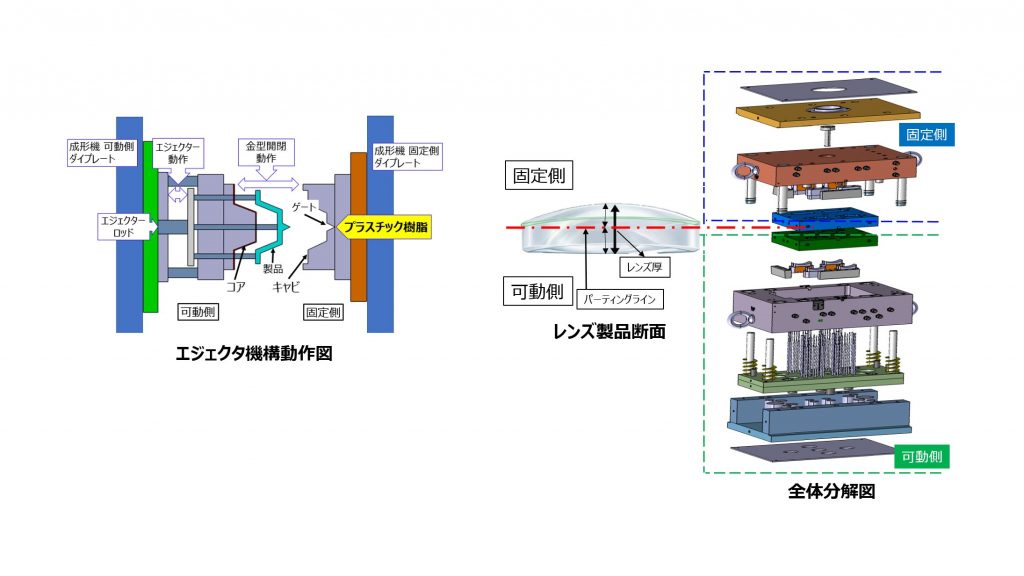
The mould is designed with an emphasis on reproducing the high shape accuracy, surface accuracy, and optical performance required for the lens, and consists of a fixed side and a movable side.
The fixed side is the mould that is fixed to the moulding machine and does not move, and it has a sprue through which resin is poured into the mould.
The movable side is the mould that moves when the mould opens and closes, and it has an ejector mechanism for removing the product.
Mold Structure: Fixed Side
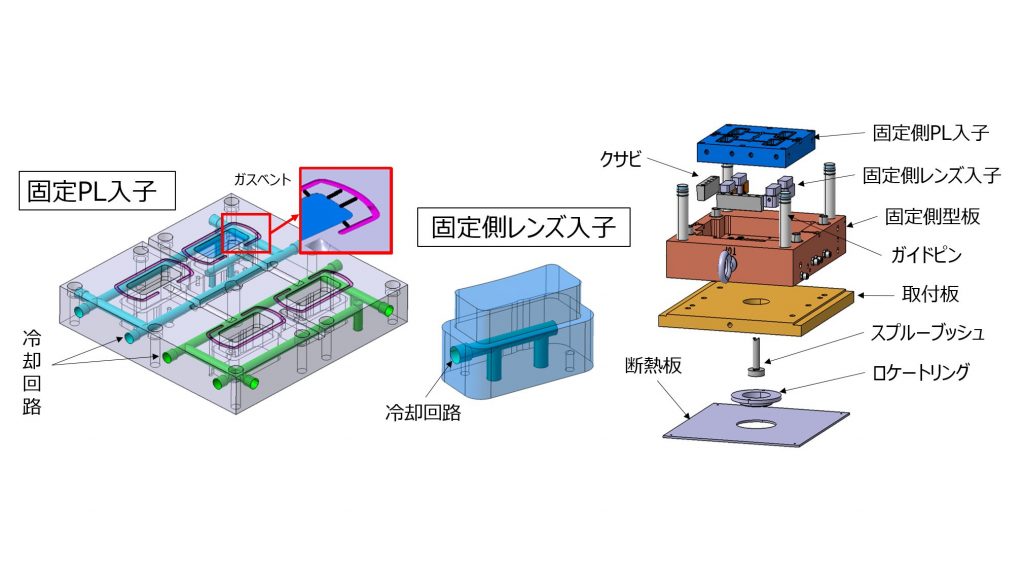
- An insulation plate suppresses disturbances in the temperature distribution during moulding.
It reduces shape errors caused by thermal expansion of the mould and variations during repeated moulding, thereby improving shape stability in mass production. - The fixed-side lens insert, which serves as the standard for shape accuracy, is arranged and plays a role in stably maintaining the lens shape during resin flow and pressurisation processes in moulding.
- The relative positioning with the movable side is managed by guide pins and guide bushes.
During mould clamping, the positional accuracy of the centre of the shape and the optical axis is ensured by positioning cotters.
This suppresses misalignment, which can cause uneven wall thickness and deterioration of the shape PV value.
Mold Structure: Movable Side
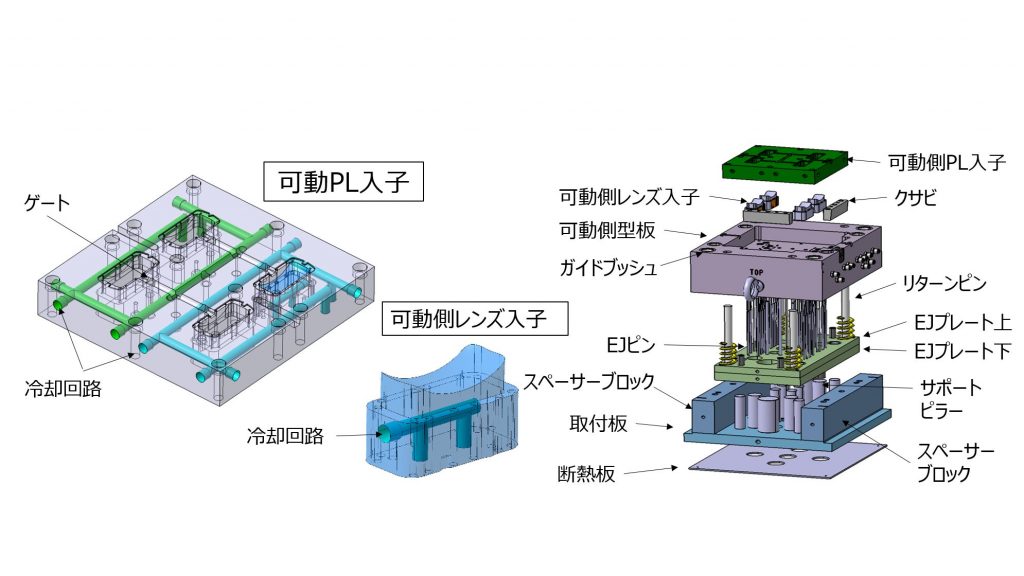
- Lens inserts are arranged, and an ejection mechanism comprising EJ (ejector) pins, an EJ plate, and return pins is provided.
In the mould release operation, the structure is designed to avoid localised stress concentration on the optical surface, minimising the occurrence of shape distortion, surface waviness, and micro-deformation after moulding. - The rigidity of the entire mould is ensured by the mounting plate and spacer blocks, and an insulation plate suppresses disturbances in the temperature distribution during moulding.
It reduces shape errors caused by thermal expansion of the mould and variations during repeated moulding, thereby improving shape stability in mass production.
Key Points Affecting Molding Quality
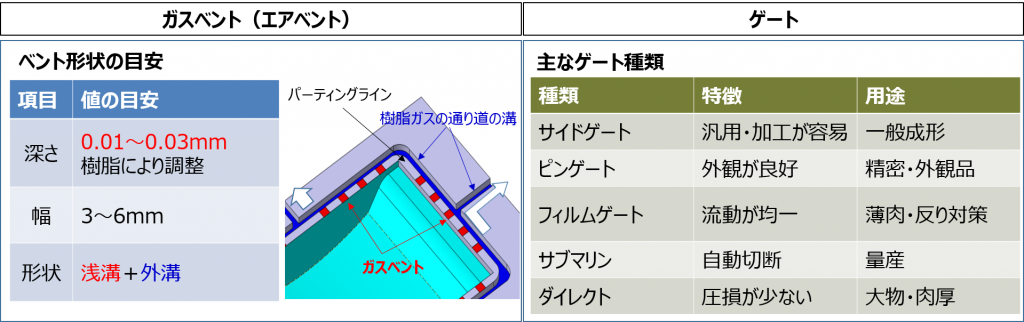
Gas vents are structures designed to prevent molding defects by allowing air and resin gases within the mould to escape as molten resin flows in.
They are most effective when placed at the final filling area, thin-walled sections, and shut-offs. Insufficient venting can lead to molding defects, while excessive venting can cause flash.
The gate is a critical component that controls the resin filling state, determining the flow pattern and finish.
The optimal position, width, and thickness are set according to the product's shape.
Common molding defects include short shots, gas burns, weld lines, gate marks, blushing, sink marks, and dimensional inaccuracies.
In practice, insufficient venting is often cited as the cause of many molding defects.
Precision Machining of Lens Designs
The most crucial point in the high-precision machining of lens surfaces
Multiple factors are intricately involved, such as 'machine kinematic accuracy', 'temperature control', and 'measurement and correction technology'.
5 Steps in Machining Lens Moulds
- Rough Machining (Forming Approximate Shape)
- Semi-Finishing (Approaching the Final Shape)
- Finishing (Achieving Nanoscale Precision)
- Measurement (Visualising Shape Errors with 3D Measurement)
- Correction Machining (Reprocessing Based on Measurement Results)
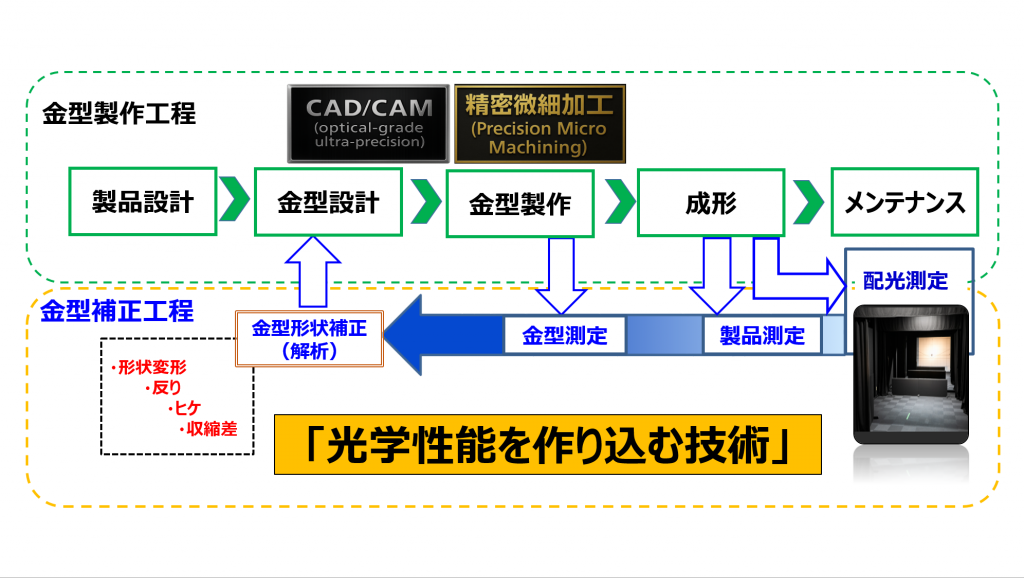
「加工 → 測定 → 補正」のループがレンズ金型の本質です。
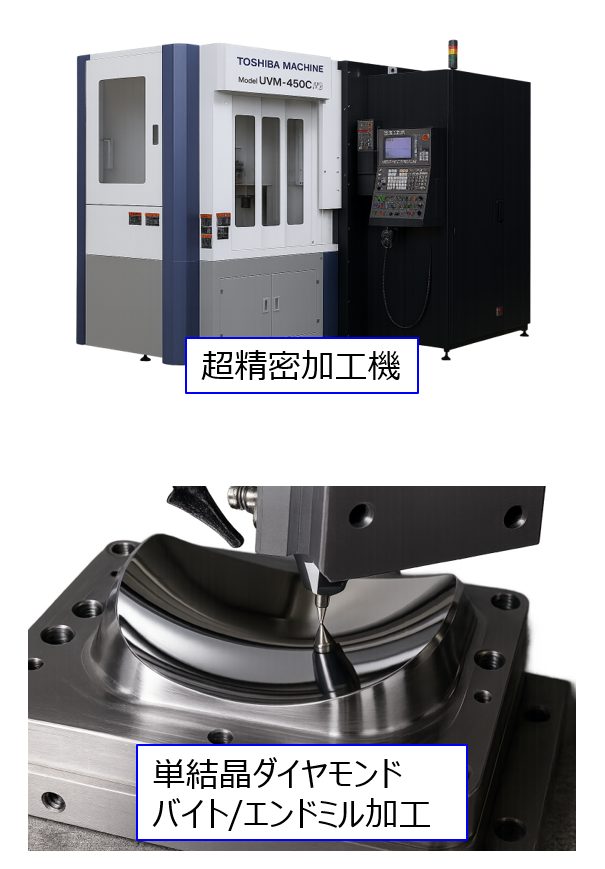
Even errors of a few microns can affect optical performance, making the control of tool wear and temperature fluctuations during machining essential!
This is considered the most high-value and challenging field within mould manufacturing.
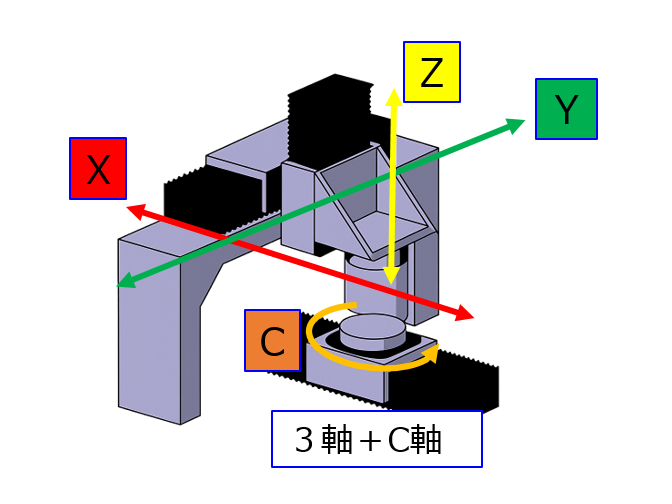
Complex non-spherical lens shapes are handled by combining 3-axis machining with C-axis control.
Lens Mold Manufacturing Flow
Manufacturing processes that pursue optical precision to the extreme
Precision to be Managed
Fundamentals of Precision Control in Optical Products
- Shape Accuracy

- Dimensional Accuracy

- Surface Roughness
- Positional Accuracy (Centricity/Concentricity)
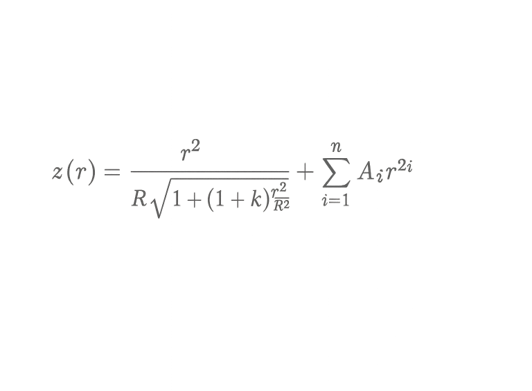
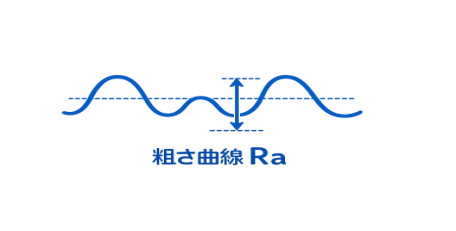
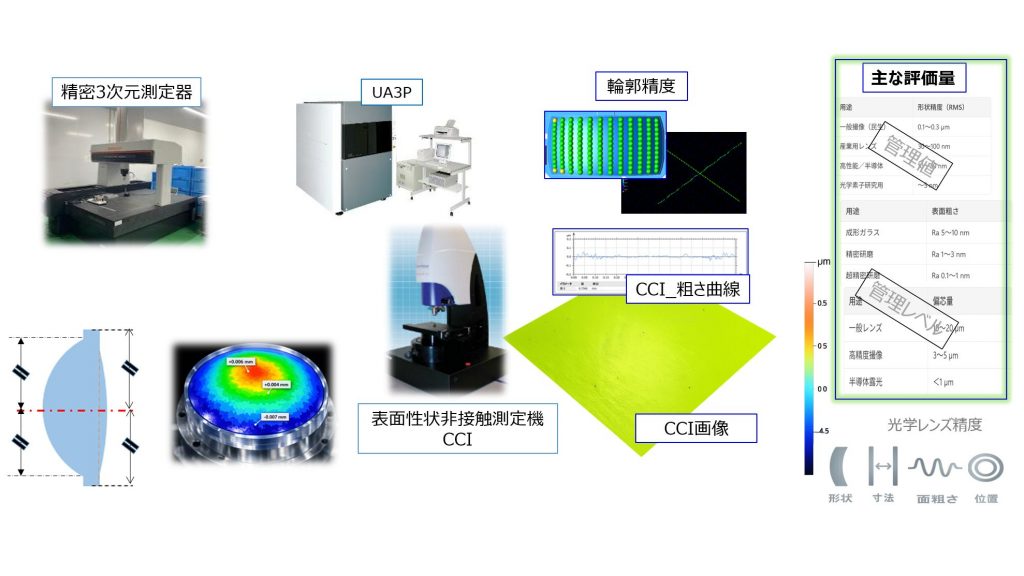
The precision of optical lenses can be broadly classified into four categories: shape accuracy, dimensional accuracy, surface roughness, and positional accuracy.
Shape accuracy refers to whether the curved surface of the lens mould matches the design. Dimensional accuracy relates to the correctness of dimensions such as outer diameter, thickness, and steps. Surface roughness indicates the smoothness of the mould surface. Positional accuracy refers to the deviation of the lens centre from its outer diameter and the concentricity of the light entry and exit surfaces.
We achieve ultra-high precision through rigorous error management in the nano to micron range.
Reasons for Being Chosen: The Power to Create Value
― Mould Optimisation Based on Experience ―

・Related links within the site:
Technical Information | Optical Product Design & Manufacturing Technology
Technical Information | Mould Design, Manufacturing & Maintenance
Technical Information | Automotive Headlamp Optical Measurement (25m Dark Room)
Product Information | Aspheric (Freeform) Lenses
Product Information | Microprism Arrays for Communication Lighting
Product Information | Inner Lenses & Light Guides for Automotive Lamps